Hiking requires more than cardiovascular endurance. Strong legs help you climb, control your body on descents, handle uneven terrain, and keep moving when the miles start adding up.
That’s where strength training can make a big difference.
You don’t need to spend hours in the gym or follow a complicated program. Two well-planned strength workouts each week can help you build the leg, hip, and core strength that carries over to the trail.
These 10 strength training exercises for hiking focus on movements I regularly use when training hikers for day hikes, backpacking trips, and longer trekking adventures.
Why Strength Training Is Important for Hiking
Walking and hiking are obviously important parts of preparing for a hike, but they don’t develop every aspect of fitness you’ll need on the trail.
Hiking often requires you to repeatedly step up onto rocks, climb steep grades, control your body while descending, balance on uneven surfaces, and sometimes carry a loaded backpack.
Strength training can help prepare you for those demands by developing:
- Single-leg strength
- Glute and hip strength
- Quad strength for climbing and descending
- Hamstring strength
- Calf strength
- Core stability
- Balance and control
- Strength for carrying a backpack
The goal isn’t to replace hiking with strength training. The two work together.
10 Best Strength Training Exercises for Hiking
You don’t need to do all 10 exercises in one workout. Later in this article, I’ve divided them into two simple strength workouts you can perform during the week.
1. Step-Ups
Step-ups are one of my favorite exercises for hikers because the movement closely resembles what you do repeatedly while climbing a trail.
They develop strength through the quads and glutes while also requiring you to stabilize on one leg.
How to do them:
Stand in front of a sturdy step or box. Place one foot completely on the step and drive through that leg to stand up. Lower yourself back down with control.
Try to avoid pushing excessively off your trailing foot.
Start with body weight and add dumbbells as you get stronger.
Reps: 3 sets of 8–12 per leg
2. Bulgarian Split Squats
Bulgarian split squats build substantial single-leg strength through the quads and glutes.
They can be especially useful for hikers because hiking involves thousands of repeated steps where one leg is doing much of the work.
How to do them:
Place your back foot on a bench or other elevated surface. Keep most of your weight through your front leg as you lower your body toward the floor.
Push through the front foot to return to standing.
If elevating the back foot feels uncomfortable or makes balance difficult, start with a regular split squat instead.
Reps: 3 sets of 8–10 per leg
3. Step-Downs
Hikers spend a lot of time training for the climb, but descending can be just as demanding.
Step-downs train your quads to control your body as you lower yourself, making them particularly useful for preparing for downhill hiking.
How to do them:
Stand on a low step with one foot near the edge. Slowly bend your standing leg and lower the opposite heel toward the floor.
Keep the movement controlled rather than dropping quickly.
Start with a low step. Increase the height or add weight as your strength and control improve.
Reps: 3 sets of 8–12 per leg
4. Romanian Deadlifts
Romanian deadlifts strengthen the hamstrings, glutes, and muscles involved in the hip-hinge movement.
They complement exercises such as step-ups and split squats, which place more emphasis on the knees and quads.
How to do them:
Hold dumbbells in front of your thighs. Keep a slight bend in your knees and push your hips backward while lowering the weights.
Keep the weights close to your legs and maintain a controlled position through your trunk.
Drive your hips forward to return to standing.
Reps: 3 sets of 8–12
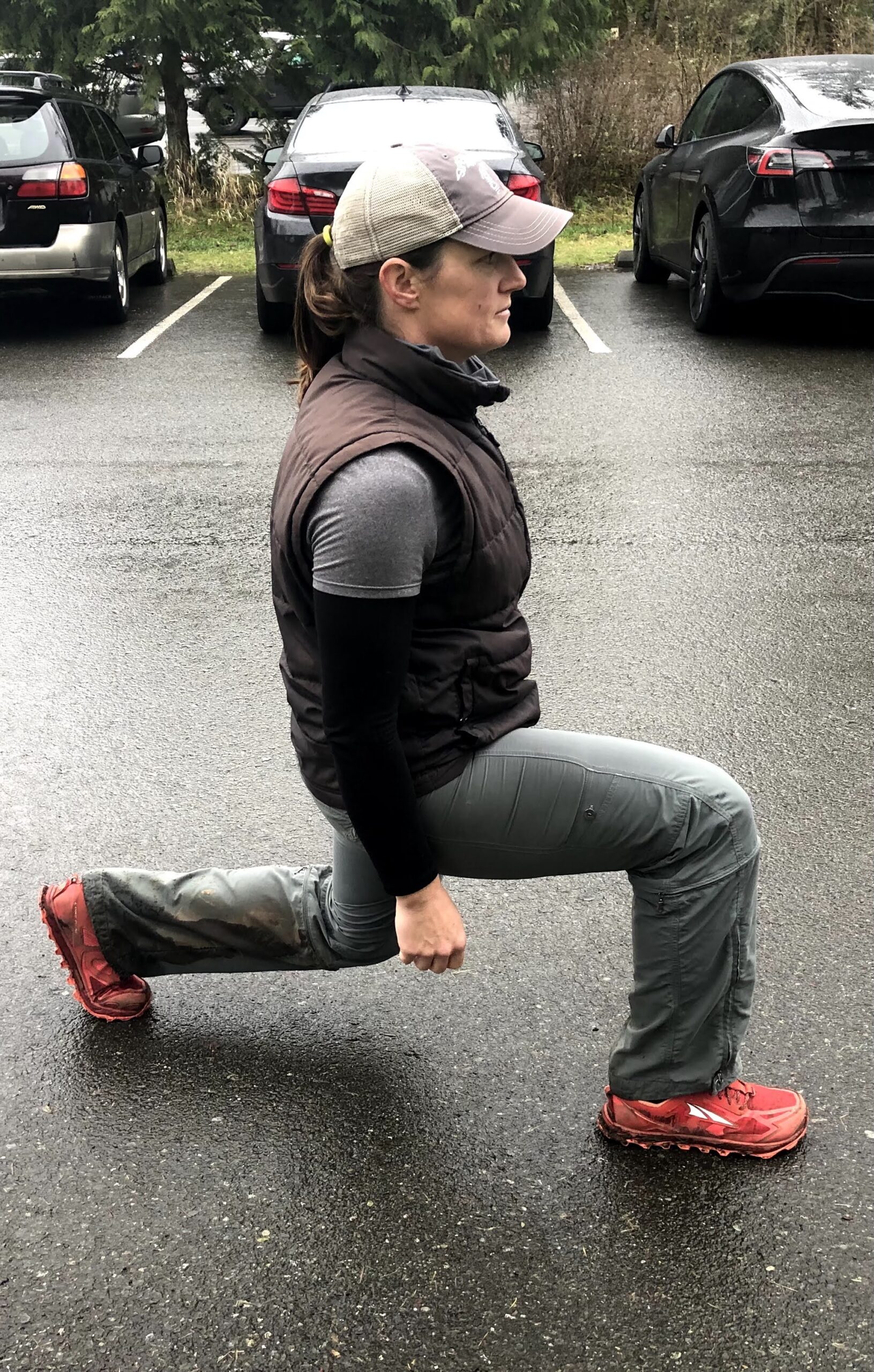
5. Reverse Lunges
Reverse lunges develop single-leg strength, balance, and coordination.
They also give you another way to train the quads and glutes without needing a step or box.
How to do them:
Stand tall and step one foot backward. Lower your back knee toward the floor while keeping your front foot planted.
Push through your front leg to return to standing.
Once body-weight lunges feel comfortable, hold dumbbells to increase the challenge.
Reps: 3 sets of 8–10 per leg
6. Single-Leg Romanian Deadlifts
Single-leg Romanian deadlifts combine hip strength with balance and single-leg control.
That makes them useful for hiking, where your feet are rarely landing on perfectly flat and predictable surfaces.
How to do them:
Stand on one leg with a slight bend in your knee. Hinge forward from your hip while allowing your opposite leg to extend behind you.
Keep your hips relatively square and return to standing with control.
If balance is limiting you, lightly hold onto a wall or sturdy object. The goal is to strengthen the movement, not turn the exercise into a balance contest.
Reps: 3 sets of 8–10 per leg
7. Lateral Band Walks
Lateral band walks strengthen the muscles around the hips that help control the position of your legs while walking, climbing, and moving over uneven terrain.
How to do them:
Place a resistance band above your knees or around your lower legs.
Slightly bend your knees and hips, then step sideways while maintaining tension on the band.
Keep your feet facing forward and avoid allowing your knees to collapse inward.
Reps: 2–3 sets of 10–15 steps each direction
8. Calf Raises
Your calves work constantly while hiking, particularly during climbing.
Calf raises are simple, but they’re easy to overlook in a hiking strength program.
How to do them:
Stand with your feet approximately hip-width apart. Rise onto the balls of your feet, pause briefly, and lower yourself slowly.
Progress to single-leg calf raises or hold dumbbells when regular calf raises become easy.
Reps: 3 sets of 12–20
9. Loaded Carries
Loaded carries train your grip, core, shoulders, and postural strength while you’re moving.
That’s useful for hikers and backpackers who need to maintain a stable position while carrying weight for extended periods.
How to do them:
Hold a dumbbell or kettlebell in each hand and walk while maintaining a tall, controlled posture.
You can also perform a suitcase carry by holding weight on only one side, which increases the demand on your core.
Time: 3 rounds of 30–60 seconds
10. Pallof Press
You don’t need dozens of abdominal exercises to build a strong core for hiking.
The Pallof press teaches you to resist rotation and maintain a stable trunk while force is pulling you sideways.
How to do it:
Attach a resistance band or cable around chest height. Stand sideways to the anchor point and hold the handle at your chest.
Press your hands straight in front of you without allowing your torso to rotate toward the anchor.
Pause, return your hands to your chest, and repeat.
Reps: 3 sets of 8–12 per side
Two-Day Strength Training Workout for Hikers
You can divide these 10 hiking exercises into two workouts rather than trying to complete everything at once.
Hiking Strength Workout A
- Step-Ups — 3 × 8–12 per leg
- Romanian Deadlifts — 3 × 8–12
- Reverse Lunges — 3 × 8–10 per leg
- Calf Raises — 3 × 12–20
- Pallof Press — 3 × 8–12 per side
Hiking Strength Workout B
- Bulgarian Split Squats — 3 × 8–10 per leg
- Step-Downs — 3 × 8–12 per leg
- Single-Leg Romanian Deadlifts — 3 × 8–10 per leg
- Lateral Band Walks — 2–3 × 10–15 steps each direction
- Loaded Carries — 3 × 30–60 seconds
Leave at least a day between strength workouts when possible.
How Heavy Should Hikers Lift?
Your strength workouts should be challenging enough to make you stronger.
If you finish a set of 10 repetitions and feel like you easily could have completed another 10, the resistance probably isn’t challenging enough to drive much progress.
At the same time, you don’t need to take every set to failure.
Choose a weight that allows you to complete your repetitions with good control while making the last few repetitions noticeably more difficult.
As you get stronger, gradually increase the weight, repetitions, or difficulty of the exercise.
How Often Should Hikers Strength Train?
For most recreational hikers, two strength workouts per week is a practical starting point.
That leaves room in your week for hiking, walking, cardiovascular training, hills, and recovery.
If you’re already following a more extensive strength program, you don’t necessarily need to add two additional hiking workouts. Instead, incorporate some of these exercises into the training you’re already doing.
Consistency matters more than trying to fit every possible exercise into your week.
Don’t Forget to Train for the Actual Hike
Strength training is only one part of preparing for hiking.
You also need time on your feet.
As your hike or trip gets closer, gradually include longer walks or hikes, hills or stairs, and terrain that resembles what you’ll encounter on your trip.
If you’ll be carrying a backpack, progressively include your pack during some training hikes as well.
For longer trips, your training should consider the distance, elevation gain and loss, terrain, pack weight, and number of consecutive hiking days you’ll face.
How Far Before a Hike Should You Start Strength Training?
If you have a major hike or trek planned, starting 8–12 weeks beforehand gives you time to build strength gradually.
If you already strength train consistently, you may simply need to make your existing program more hiking-specific.
If you’re starting from very little activity, give yourself more time.
Six or twelve weeks isn’t a magic number. Your starting fitness and the difficulty of your planned hike matter.
Strength Training for Downhill Hiking
If your upcoming hike includes long or steep descents, give downhill preparation some extra attention.
Exercises such as step-downs, split squats, reverse lunges, and step-ups performed with a controlled lowering phase can help develop the strength and control required for descending.
Don’t rush the lowering portion of every repetition. Controlling the movement is part of the exercise.
For more detail, read my guide to strength training for downhill hiking.
Strength Training for Hiking at Home
You don’t need a gym to build hiking strength.
Most of the exercises in this article can be performed at home with dumbbells, resistance bands, and a sturdy step or bench.
If you prefer training at home, my Strength Training for Hikers at Home guide includes a complete home-based approach.
Build Your Training Around Your Hike
The best exercises for hiking are useful, but they’re only part of a complete training plan.
A weekend day hike, a backpacking trip, and a multi-day trek in the mountains can require very different preparation.
Your training should take into account where you’re starting and what you’re preparing for.
That includes:
- Your current fitness
- Hiking experience
- Trip distance
- Elevation gain and loss
- Pack weight
- Terrain
- Number of hiking days
- Time available to train
If you’re preparing for a specific hike, backpacking trip, or trek and want a program built around your goals, current fitness, and trip demands, learn more about Online Hiking Training & Coaching with Aspire for Adventure.