Why Being Fit Isn’t Always Enough for Hiking
Being in good shape certainly helps on the trail, but general fitness doesn’t always prepare your body for the specific demands of hiking.
You might be able to run several miles or feel strong in the gym and still struggle with tired quads on long descents, burning calves on sustained climbs, or carrying a pack for several hours.
As a personal trainer and licensed Physical Therapist Assistant, I’ve worked with active people who are surprised by how differently their bodies respond to longer hikes and increased elevation.
Hiking combines cardiovascular endurance with leg strength, balance, stability, and the ability to climb and descend uneven terrain repeatedly. If you’re preparing for a more challenging hike, your training should reflect those demands.
A simple hiking training program should include three things:
- Strength training to prepare your legs, hips, and core
- Hills, stairs, or incline-based cardio to develop climbing endurance
- Progressively longer walks or hikes to build time on your feet
You don’t need a complicated program. You need consistent training that becomes progressively more similar to the hike you’re preparing for.
Why General Fitness Doesn’t Always Carry Over
Hiking is often thought of primarily as cardiovascular exercise, but there’s much more going on.
Running can build excellent cardiovascular endurance, but it doesn’t fully prepare your legs for hours of climbing and descending. Likewise, traditional strength training is valuable, but a gym program may not address all of the balance, stability, and muscular endurance required on uneven terrain.
On the trail, your body has to repeatedly:
- Control your weight while descending
- Produce force while climbing
- Balance and stabilize on uneven terrain
- Spend extended periods on your feet
- Maintain posture and stability while carrying a pack
The more demanding the hike becomes, the more important these hiking-specific abilities become.
Why Aches and Pains Can Show Up on the Trail
Longer distances and increased elevation can expose weaknesses or simply exceed what your body is currently accustomed to.
For example, long descents place considerable demand on the quadriceps as they control your body with each step. Building eccentric leg strength through exercises such as step-downs and reverse lunges can help prepare your legs for that demand.
Long climbs place repeated demands on the calves, glutes, and cardiovascular system. Carrying a backpack adds another challenge by increasing the load your legs and trunk need to manage.
This doesn’t mean every case of knee, hip, Achilles, or back pain has the same cause. Pain can have many contributing factors. From a training standpoint, the goal is to progressively prepare your body for the workload you expect to encounter rather than suddenly asking it to handle a major increase in distance, elevation, or pack weight.
What Hiking Actually Requires
Good hiking fitness is a combination of strength, endurance, balance, and control.
Some particularly useful qualities to develop include:
- Eccentric leg strength for controlling descents
- Single-leg strength and stability for uneven terrain
- Glute and hip strength for climbing
- Core endurance for maintaining stability, especially with a pack
- Calf strength and endurance for sustained climbing
- Cardiovascular endurance for longer periods of continuous activity
You don’t need to train like a competitive athlete. Your training simply needs to prepare you for what you’ll encounter on the trail.
Common Hiking Training Mistakes
One of the biggest mistakes is increasing hiking difficulty faster than your body has had time to adapt.
Other common mistakes include:
- Relying only on occasional hikes to get in shape
- Skipping strength training
- Increasing mileage or elevation too quickly
- Training only on flat terrain for a hike with significant climbing
- Ignoring downhill preparation
- Waiting until the final few weeks to start carrying a backpack
- Making every workout hard instead of allowing time for recovery
A good program gradually increases the demands of training as your strength and endurance improve.
How to Train for Hiking Without Overcomplicating It
For many hikers, a good weekly training schedule can be relatively simple:
- 2 strength-training sessions
- 1–2 cardiovascular sessions, ideally including some hills, stairs, or incline work
- 1 progressively longer hike or walk
- Appropriate rest and recovery between harder sessions
Your exact schedule should depend on your current fitness level and the hike you’re preparing for. Someone training for a five-mile day hike doesn’t need the same program as someone preparing for a multi-day backpacking trip.
If you want a structured progression, you can also follow my 12-Week Hiking Training Plan.
Best Exercises for Hiking
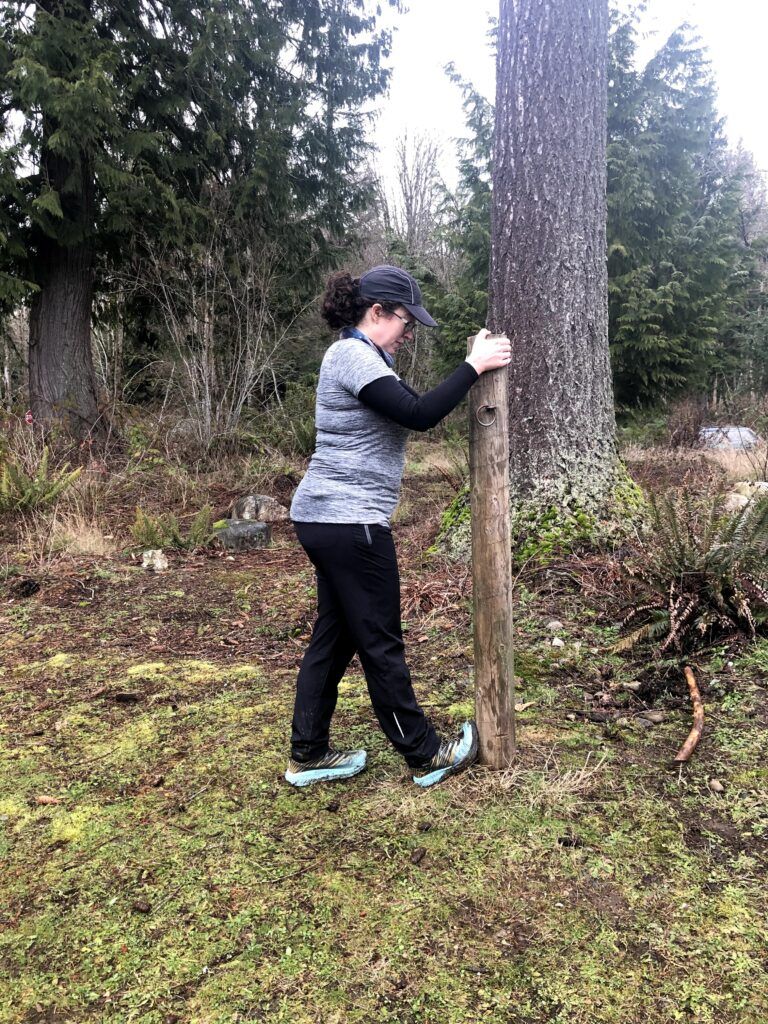
You don’t need dozens of specialized hiking exercises. A handful of well-chosen movements can cover many of the physical demands you’ll encounter on the trail.
Step-ups — Build single-leg strength and closely resemble the repeated climbing motion used while hiking.
Reverse lunges — Develop leg and hip strength while challenging balance and control.
Romanian deadlifts — Strengthen the glutes, hamstrings, and posterior chain.
Step-downs — Particularly useful for developing the controlled leg strength required during descents.
Calf raises — Build calf strength and endurance for climbing and extended time on your feet.
Rows — Strengthen the upper back, which can be useful when carrying a backpack.
Planks, carries, or anti-rotation exercises — Develop the core strength and endurance needed to maintain stability while moving and carrying a pack.
Simple Hiking Strength Workout
Here’s a straightforward workout you can use as a starting point:
- Step-ups — 3 × 10 each leg
- Reverse lunges — 3 × 8 each leg
- Romanian deadlifts — 3 × 8–10
- Step-downs — 2 × 8 each leg
- Calf raises — 3 × 12–15
- Plank — 2–3 × 30–45 seconds
Choose resistance that allows you to maintain good control and technique. As the exercises become easier, gradually increase the resistance, repetitions, or difficulty rather than trying to make huge jumps from one workout to the next.
Don’t Forget to Train for Descents
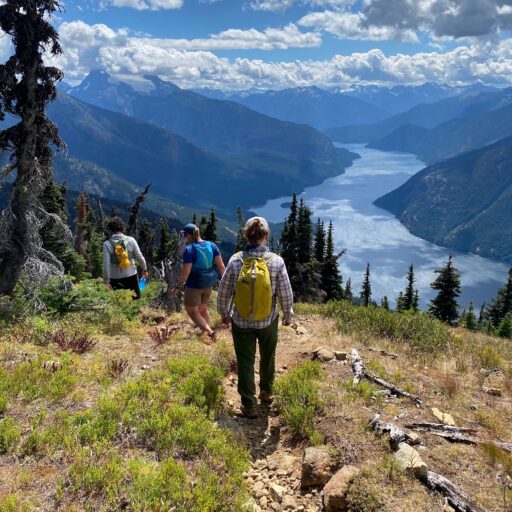
Climbing gets most of the attention because it’s usually the part that leaves you breathing hard. But long descents can be just as demanding on your legs.
Exercises such as step-downs, reverse lunges, and controlled split squats can help develop the eccentric strength needed to repeatedly lower your body under control.
Your actual hiking is valuable here too. As your training progresses, include trails with climbing and descending rather than doing all of your conditioning on flat ground.
Trekking poles can also be useful on steep or prolonged terrain, particularly when carrying a pack.
Train for the Hike You’re Actually Doing
As your trip gets closer, your training should become more specific.
If you’re preparing for a hike with significant elevation, include hills or incline training. If you’ll carry a backpack, gradually practice with a pack. If you’re preparing for a long day on the trail, progressively increase your time on your feet.
For a multi-day trek, you may also benefit from occasionally training on consecutive days so you experience hiking when your legs aren’t completely fresh.
The goal isn’t to make every workout as difficult as possible. It’s to gradually make your body more capable of handling the specific demands of your adventure.
Train for the Trail, Not Just the Workout
Hiking should be challenging—that’s part of what makes it rewarding. But there’s a difference between being appropriately challenged and feeling completely unprepared.
Building strength, cardiovascular fitness, hiking endurance, and familiarity with the terrain can make a big difference in how you feel on the trail.
Training for hiking doesn’t need to be extreme or complicated. It needs to be consistent, progressive, and specific to where you’re going.
Want Training Built Around Your Hike?
If you’re preparing for a specific hike, backpacking trip, or multi-day trek, I offer personalized online hiking training based on your current fitness, schedule, available equipment, and the demands of your adventure.
Learn more about personalized online hiking training and coaching.